
The Stairlift Decision Journey: What the Data Tells Us About When and Why People Buy (2026)
The average age of first stairlift installation in the UK has fallen from 87 to 74 years old over the past 15 years — a 1% decline every year. People are finally buying sooner. But the data shows millions are still waiting too long.
Source: Kudos Stairlifts Customer Database (2024)
Most people who eventually get a stairlift don't buy one the moment they first struggle on the stairs. They wait — sometimes months, sometimes years. They tell themselves they're managing fine. They worry about the cost. They're not sure where to start. A family member objects. Then something happens: a fall, a close call, a health scare, a conversation with a GP.
What does the evidence actually say about this decision journey? When do people buy, why do they wait, what finally pushes them to act — and what does delaying cost them? This article synthesises the best available UK research data to answer those questions.
1 The Declining Age Trend: People Are Buying Earlier
| Time Period | Avg Age of New User | Change | Source |
|---|---|---|---|
| 15 years ago | 87 years old | — | Kudos Stairlifts, 2024 |
| 10 years ago | 81 years old | −6 years | Kudos Stairlifts, 2024 |
| 5 years ago | 77 years old | −4 years | Kudos Stairlifts, 2024 |
| Today (2024) | 74 years old | −3 years | Kudos Stairlifts, 2024 |
| Projected 2033 | ~64 years old | −10 years (projected) | Kudos Stairlifts, 2024 |
It's worth noting the limitation in this data: it reflects one UK supplier's customer base, with no disclosed dataset size or methodology. It's the only longitudinal age-at-purchase data available in the public domain — which itself is telling. No academic study has yet tracked this metric systematically across the industry.
What's driving the earlier adoption? Kudos attributes it to rising life expectancy, a stronger desire to remain in the family home, and a gradual erosion of the stigma that once surrounded mobility aids. There's also a practical dimension: home stairlifts have become more discreet, faster to install, and more financially accessible through grants and rental options.
2 Why Do People Wait? The 5 Biggest Barriers
Researchers at Lancaster University and Liverpool John Moores University surveyed 359 UK adults aged 55 and over, plus 41 occupational therapists and other professionals. They found the following barriers to adopting stair-fall prevention interventions — including stairlifts:
Source: Pye et al., Healthcare (MDPI), June 2025. DOI: 10.3390/healthcare13121307. n=359 UK adults 55+, n=41 professionals.
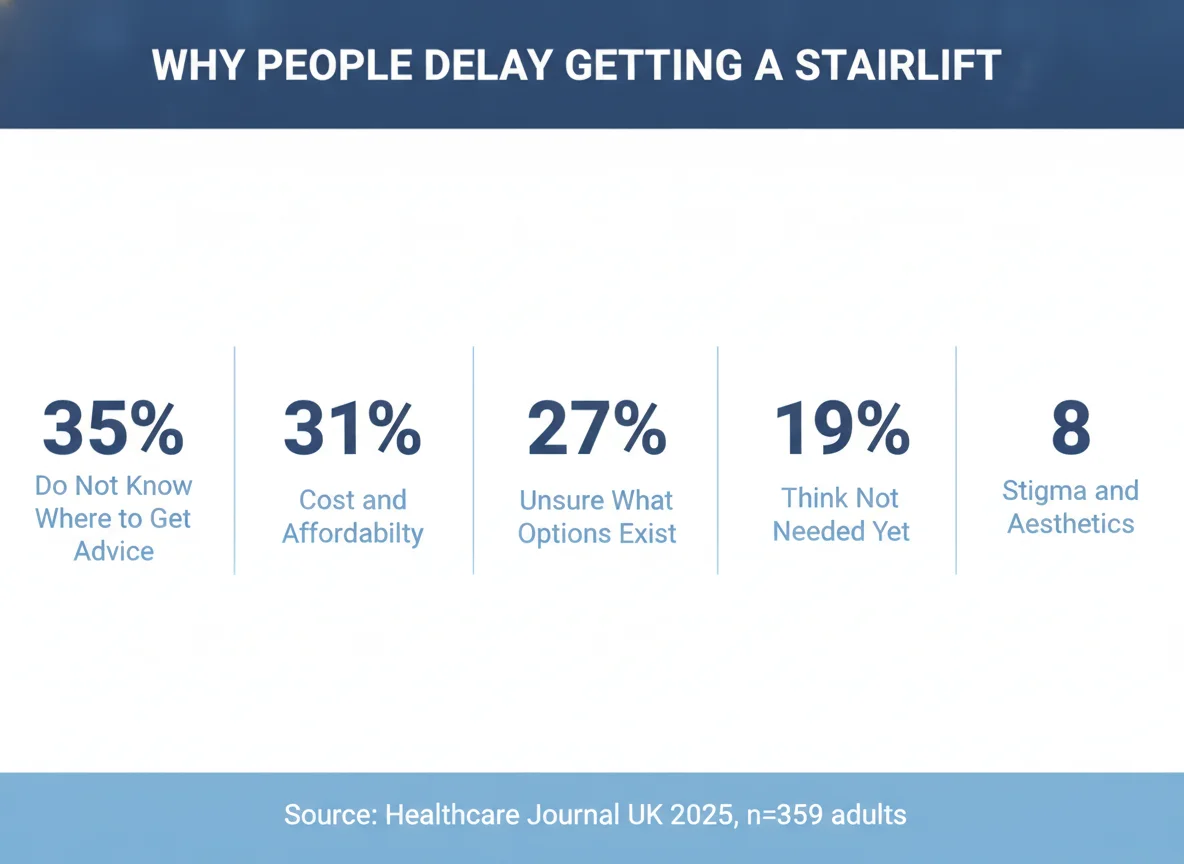
The gap between general concern and personal risk perception is striking: 92% of participants agreed stair falls are a serious concern, but only 67% considered themselves personally at risk — a 25-percentage-point gap. This pattern — "it's a real problem, just not for me" — is one of the most consistent findings in health behaviour research, and it's clearly at play in the stairlift decision.
On the household dynamics barrier (16%): qualitative research from the University of Bristol found this is more complex than simple refusal. Occupational therapists in the 2025 study were candid about this dynamic: "People are really proud of their carpets. Unless somebody's had the experience of falling they wouldn't accept it aesthetically."
For those concerned about the cost barrier, a stairlift rental arrangement or a reconditioned stairlift can significantly reduce the upfront outlay, and the Disabled Facilities Grant may cover costs entirely for eligible households.
3 What Finally Triggers the Decision?
| Trigger / Facilitator | % Citing | Source |
|---|---|---|
| Better understanding of benefits | 53% | Healthcare Journal, 2025 |
| Professional referral (GP / OT) | 27% | Healthcare Journal, 2025 |
| Practical / financial support | 22% | Healthcare Journal, 2025 |
| Personalised approach / tailored advice | 21% | Healthcare Journal, 2025 |
| Social encouragement from family or peers | 18% | Healthcare Journal, 2025 |
| Endorsement by health professional | 17% | Healthcare Journal, 2025 |
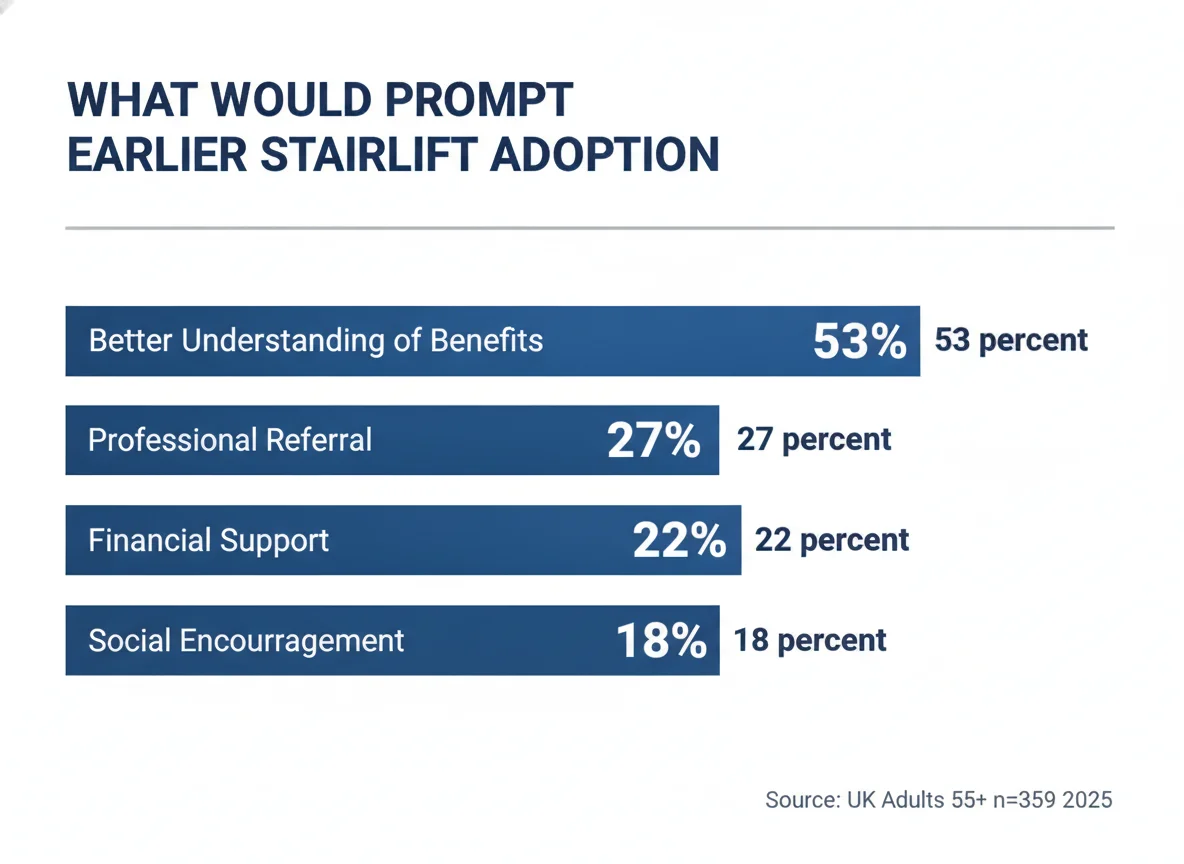
The qualitative picture from the Bristol CSCW study (2021) adds important texture to these numbers. Researchers who interviewed stairlift users and their household members in the UK found that the adoption journey consistently involved three phases: conflict (resistance, disagreement about whether one was needed), trauma (a triggering event — usually a fall or health deterioration), and catharsis (acceptance, relief, and often a significant improvement in quality of life after installation). The "trauma" trigger phase is the most critical — and also the most avoidable.
Professional referral is a more powerful trigger than the headline 27% figure suggests. Understanding what happens during a free stairlift survey is often the step that converts consideration into decision, as it removes uncertainty about practicality, cost, and installation disruption.
"Older adults often only consider or accept interventions once something goes wrong — the reactive rather than proactive model remains dominant, despite strong evidence that earlier adoption would be more beneficial."— Qualitative finding, Pye et al., Healthcare (MDPI), June 2025
Social context also matters significantly. A 2025 ELSA-based study (following 2,000+ UK adults over 2004–2019) found that unpartnered older adults have measurably lower odds of getting housing adaptations. Those who rely on walking sticks or grab rails as interim measures may also be delaying a stairlift that would offer substantially better safety, particularly given that 63% of stair falls occur on descent — where grip aids are least effective.
4 How Long Does the Process Take Once You Decide?
| Stage of DFG Process | Average Duration | Bottleneck |
|---|---|---|
| Referral / initial contact | ~41 days | OT resource shortage; wide variation between councils |
| OT assessment | ~46 days | Leading cause of delay: OT staffing levels |
| Grant approval and specification | Varies widely | Multiple organisations involved |
| Installation | Days (private) / weeks (LA) | Private purchase significantly faster |
| Total DFG process (2/3 of councils) | 6+ months | Two-thirds of councils exceed 6 months total |
A key finding from the 2020 UK-wide pathway study is that the 5-stage adaptation process involves multiple organisations — the local authority, the NHS, OT teams, contractors — with poor coordination between them identified as a major systemic barrier. The research found huge variation in OT-per-population ratios across different areas, which directly drives the disparities in waiting times.
Long public system delays push better-resourced households to go private, while middle-income households — who don't qualify for full DFG support but can't easily self-fund — are the most excluded group. Understanding how much a stairlift actually costs in the Manchester area, versus what a DFG covers, is essential context.
5 The Hidden Cost of Waiting Too Long
| Metric | Value | Source |
|---|---|---|
| Annual NHS cost of falls (England) | £2.3 billion | NHS Confederation |
| Daily NHS cost of falls | £6 million | NHS Confederation |
| Over-65s who fall at least once a year | 33% | NHS / ONS |
| Over-80s who fall at least once a year | 50% | NHS / ONS |
| Stair falls occurring on descent (higher risk) | 63% | Healthcare Journal, 2025 |
| Adults 55+ who have already fallen on stairs | 56% | Healthcare Journal, 2025 |
| Wales study: population who received adaptations | 657,536 adults | BMC Health Services, 2022 |
The Welsh data-linkage study (covering 657,536 adults across 2010–2017) provided population-level confirmation that home adaptations reduce emergency fall-related hospital admissions. For households in Manchester and the surrounding area, the decision isn't simply personal; delayed adaptation represents a predictable cost to NHS emergency services.
The 2025 ELSA longitudinal study — tracking 2,000+ UK adults from 2004 to 2019 — adds the strongest evidence for earlier adoption. It found that housing adaptations are most beneficial for people who are still in relatively good health at the time of installation. The protective health benefit diminishes when installation happens after significant deterioration.
Decision Readiness Self-Assessment
A short, evidence-informed self-check based on the patterns identified in UK research. Five questions, about 60 seconds. No data is collected or sent anywhere — your answers stay in your browser.
Frequently Asked Questions
How do I know when I actually need a stairlift?
What is the average age of stairlift users in the UK?
What triggers most people to finally get a stairlift?
How long does the Disabled Facilities Grant process take?
Is it better to get a stairlift earlier rather than waiting?
Why do so many people resist getting a stairlift?
Can I get financial help towards the cost of a stairlift in Manchester?
Methodology
This article synthesises data from peer-reviewed academic studies, official UK government sources, and one industry proprietary dataset. All statistics are attributed to their primary source and dated.
- Sources consulted: 12 sources across academic journals, government, charity reports, and industry
- Sources cited: 9 primary or authoritative secondary sources
- Data date range: 2004–2026 (ELSA longitudinal) to June 2025 (most recent peer-reviewed study)
- Primary peer-reviewed studies: Pye et al. (Healthcare, June 2025); Zhao et al. (Age & Ageing, February 2025); Parkin et al. (IJERPH, 2020); Griffiths et al. (BMC Health Services, 2022)
- Last verified: June 2026
- Update schedule: Annually, or when new peer-reviewed data is published
Sources & References
- Pye, J. et al. "Older Adults' and Professionals' Attitudes Towards Stair-Fall Prevention Interventions." Healthcare (MDPI), June 2025. PMC12154242.
- Zhao, Y. et al. "Housing Adaptations and Older Adults' Health Trajectories: Evidence from ELSA." Age & Ageing, February 2025. PMC11831028.
- Kudos Stairlifts. "Why the Average Age of a Stairlift User Is Changing." July 2024. kudosstairlifts.co.uk.
- Parkin, A. et al. "Older Clients' Pathway through the Adaptation System for Independent Living in the UK." IJERPH, 2020. PMC7277662.
- Griffiths, S. et al. "Home Adaptations and Emergency Hospital Admissions due to Falls: Wales Data-Linkage Study." BMC Health Services Research, 2022. PMC8753038.
- University of Bristol / ACM. "Aging in Place Together: The Journey Towards Adoption and Acceptance of Stairlifts in Multi-Resident Homes." ACM HCI, October 2021. doi:10.1145/3476061.
- Age UK. "Home Adaptations: Delays and Access Report." 2024.
- MHCLG / HM Treasury. "Disabled Facilities Grant: Budget Allocation 2025–26."
- Trauma Audit and Research Network (TARN) / NHS Digital. "Falls as Leading Cause of Death in Over-65s."